
Attention-Deficit/Hyperactivity Disorder (ADHD)
Understanding ADHD
Attention-Deficit/Hyperactivity Disorder (ADHD) is a neurodevelopmental condition that affects how a person focuses, organizes, regulates energy, and manages impulses. People with ADHD may experience:
- Difficulty sustaining attention on tasks, conversations, or reading
- Feeling mentally scattered, easily distracted, or overwhelmed by details
- Restlessness or an internal sense of being “on the go”
- Challenges starting, prioritizing, or finishing tasks
- Forgetfulness, misplacing items, or losing track of time
ADHD is not laziness or a lack of effort. It reflects differences in how the brain manages attention, motivation, and executive functioning. Many people with ADHD are creative, energetic, intuitive, and resourceful—especially when their environment and supports match how their brain works.
ADHD can look very different from person to person. Some people are more inattentive, some more hyperactive/impulsive, and some experience a combination of both.
Why Seek an Evaluation?
People seek an ADHD evaluation for many reasons. Some have struggled for years with focus, organization, or “following through,” and want to know why. Others seek clarity because:
- Work or school expectations are becoming harder to manage
- They have been told they are “smart but not living up to potential”
- They are constantly overwhelmed by emails, tasks, and deadlines
- They feel chronically disorganized despite trying planners, apps, and strategies
- They were diagnosed in childhood and want an updated picture in adulthood
A comprehensive ADHD evaluation can help:
- Clarify whether ADHD is present and to what degree
- Distinguish ADHD from (or understand its overlap with) anxiety, depression, trauma, sleep problems, or autism
- Identify strengths and challenges in attention, working memory, and executive functioning
- Provide documentation for accommodations at school, on tests, or in the workplace
- Inform treatment planning and collaboration with prescribing providers or therapists
- Offer validation and language to better understand your experiences
Signs and Traits of ADHD in Adults
Not everyone with ADHD looks hyperactive. Many adults with ADHD are quiet, high-achieving, or very good at compensating. Common experiences include:
- Difficulty starting tasks, especially those that feel boring, complex, or overwhelming
- Procrastination followed by intense last-minute work under pressure
- Frequently losing items (keys, phone, cards), forgetting appointments, or missing deadlines
- Trouble finishing projects; many ideas started, fewer completed
- Feeling mentally busy or distracted, even when sitting still
- Difficulty filtering out background noise or distractions
- Emotional impulsivity or quick reactions when frustrated or overwhelmed
- Time blindness: underestimating how long tasks will take or losing track of time
- Periods of hyperfocus on tasks or topics that are highly interesting
- A long history of comments such as “not working to potential,” “disorganized,” or “needs to try harder”
Many adults with ADHD also describe strengths such as creativity, humor, big-picture thinking, resilience, and the ability to thrive in fast-paced or idea-driven environments.
This list is not a diagnostic tool, but it can be a useful starting point for reflection and discussion.
What an ADHD Evaluation Looks At
Our ADHD evaluations are individualized and neuropsychologically informed. Depending on your needs, an assessment may include:
✨ Attention & Concentration
Standardized tasks that look at sustained attention, distractibility, and mental stamina across different types of tasks.
🧠 Executive Functioning
Assessment of planning, organization, working memory, problem-solving, cognitive flexibility, and self-monitoring.
🧩 Cognitive Profile
Evaluation of overall thinking abilities, processing speed, and learning style to see how your brain works best.
📚 Academic or Work Functioning
When relevant, measures of reading, writing, and/or math, as well as how attention and executive functioning affect performance in school or at work.
🔎 Emotional & Behavioral Screening
Screening for mood, anxiety, stress, sleep issues, trauma history, or substance use that may mimic or worsen attention difficulties.
📑 Collateral Input (when desired and appropriate)
With your consent, input from partners, family members, or old report cards and records can provide additional perspective, especially when there is a long history of difficulties or suspected childhood ADHD.
🧪 Screening for Co-Occurring Conditions
Because ADHD commonly overlaps with conditions like anxiety, depression, autism, learning differences, and sleep disorders, we may explore these areas to provide a more complete picture.
How Results Can Help
Your feedback session and written report focus on clarity and practical recommendations—rather than just scores. An ADHD evaluation can help you:
- Confirm or rule out ADHD as part of your neurotype
- Understand how ADHD interacts with stress, anxiety, trauma, or other conditions
- Identify environments, strategies, and tools that support your success
- Obtain documentation for school or workplace accommodations, when appropriate
- Facilitate collaboration with prescribing providers such as primary care physicians or psychiatrists
- Build self-compassion by replacing “I’m lazy” narratives with a more accurate understanding of brain-based differences
When to Consider an ADHD Evaluation
You might consider an ADHD evaluation if:
- You have struggled for a long time with organization, follow-through, or meeting deadlines
- You feel overwhelmed by routine tasks, paperwork, or email
- You frequently procrastinate, despite caring about your responsibilities
- You have tried multiple planners, apps, or systems without lasting success
- You were told you might have ADHD and want a thorough, evidence-based assessment
- You are seeking accommodations on standardized tests, at school, or in the workplace
- You are trying to understand the difference between ADHD, anxiety, burnout, or autism
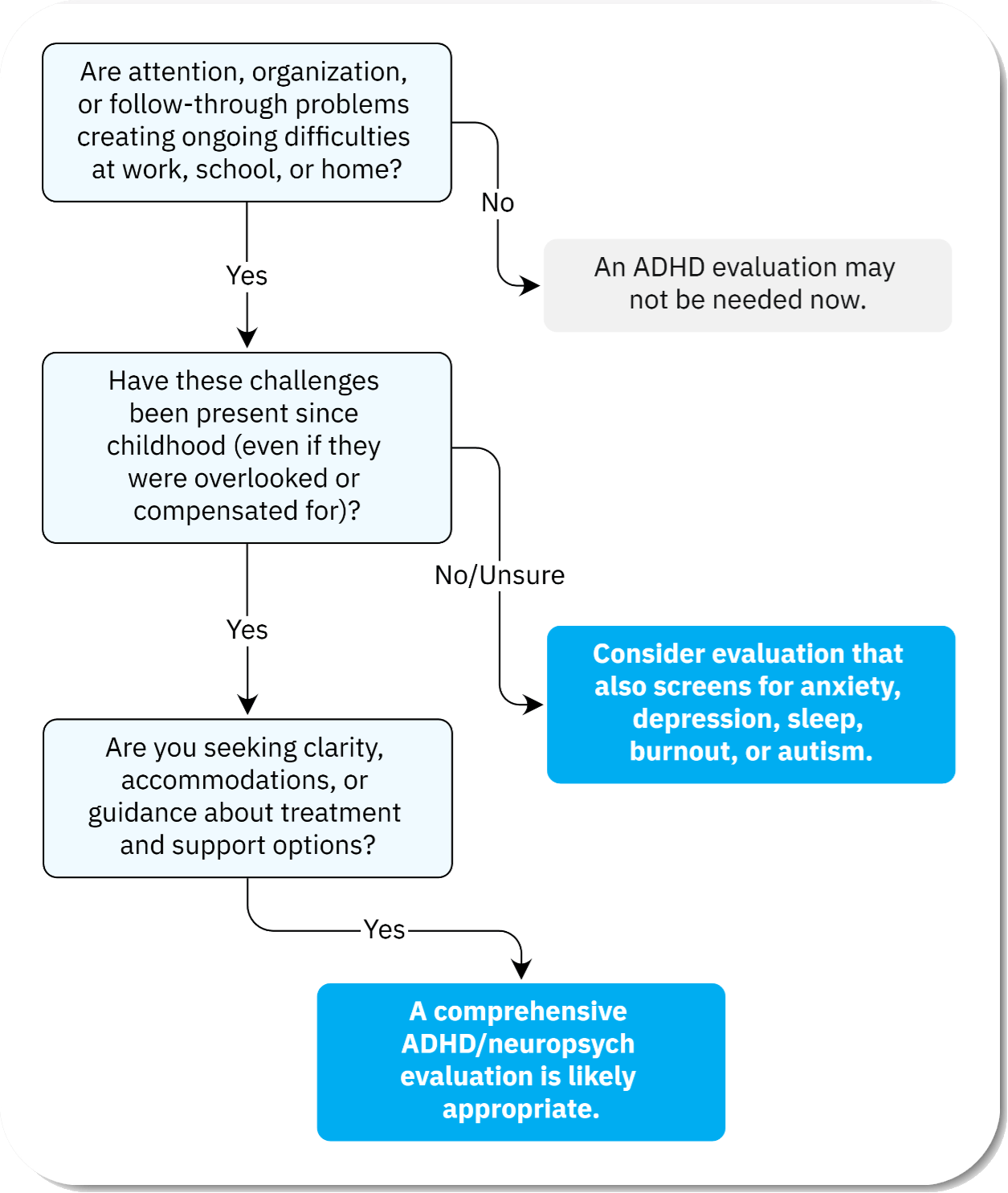
If you are unsure, the intake appointment is a space to talk through your story, ask questions, and decide together whether a focused ADHD evaluation, a broader neuropsychological evaluation, or another service is the best fit.
A Simple Decision Path
Frequently Asked Questions About ADHD Evaluations
Can adults be diagnosed with ADHD later in life?
Yes. Many people are first diagnosed in adulthood, especially if they masked, were high-achieving, or grew up in environments that made it easier to compensate. Adult diagnosis can help make sense of lifelong patterns.
What if I already take ADHD medication?
You can still benefit from a formal evaluation. Testing can clarify your specific strengths and challenges, co-occurring conditions, and guide ongoing treatment or accommodation planning. It can also be helpful if you are considering medication changes or second opinions.
How is ADHD different from anxiety or burnout?
Anxiety, trauma, chronic stress, or burnout can affect focus and memory—but usually in different patterns than ADHD. A neuropsychological evaluation looks at attention, executive functioning, and emotional factors together to clarify what is going on.
Can ADHD overlap with autism or learning differences?
Yes. ADHD commonly co-occurs with autism, learning disorders, and other neurodevelopmental conditions. Our evaluations consider this overlap to avoid oversimplifying or missing important pieces.
Do you prescribe medication?
Stillwaters focuses on assessment and recommendations. Medication management is typically handled by your primary care provider or psychiatrist. We are happy to provide a detailed report and, when appropriate, collaborate with your prescribing provider.
Is telehealth valid for ADHD assessment?
Yes. We use telehealth-friendly tools and procedures that align with best practices for psychological and neuropsychological assessment, and may recommend hybrid (in-person testing) in some circumstances.
Trusted ADHD Resources
These organizations and websites are not affiliated with Stillwaters, but they offer reliable, evidence-based information and support.
National & Online Resources
- CHADD (Children and Adults with Attention-Deficit/Hyperactivity Disorder) : Education, advocacy, support groups, and resources for children, teens, adults, and families.
- ADDA (Attention Deficit Disorder Association) : Focused on adults with ADHD; offers webinars, virtual support groups, and educational materials.
- Understood.org : Resources on ADHD, learning differences, executive functioning, and accommodations at school and work.
- ADDitude Magazine : Articles, webinars, and practical strategies for living with ADHD for adults, parents, and clinicians.
- Job Accommodation Network (JAN) : Guidance on workplace accommodations and disability rights for individuals with ADHD and other conditions.
Florida-Based Supports & Community Resources
- CHADD Local Chapters (Florida) : Several areas in Florida have CHADD chapters or support groups that offer education, peer support, and community events for families and adults with ADHD.
- Florida Division of Vocational Rehabilitation (VR) : State program that helps individuals with disabilities obtain and maintain employment, including accommodations and job coaching. ADHD can qualify when it significantly impacts work.
- Florida Colleges and Universities Disability Services: Most higher education institutions in Florida have disability services offices that support students with ADHD. A comprehensive evaluation can be used to request academic accommodations.
Crisis Resources (If You Need Immediate Help)
This page is for information and education only and cannot provide emergency support or crisis intervention. Stillwaters is not a 24/7 crisis service and does not monitor messages in real time.
If you or someone you care about is in immediate distress or at risk of harm:
- Call or text 988 — Suicide & Crisis Lifeline (24/7, U.S.).
- Call 911 if there is an urgent safety concern.
- Go to the nearest emergency room or crisis stabilization unit.
- In Florida, you can also dial 2-1-1 or visit fl211.org to connect with local crisis and support resources.
If you are unsure whether something is an emergency, you can call 988 to talk with a trained crisis counselor.
Moving Forward
An ADHD diagnosis is not a character judgment—it is a way of understanding how your brain is wired so you can work with it, not against it.
During your intake appointment, we will:
- Talk about your history, current concerns, and goals
- Explore whether ADHD, another condition, or a combination may be contributing to your difficulties
- Decide together whether a focused ADHD evaluation or a broader neuropsychological evaluation is the best fit
You can learn more about the types of evaluations we offer by visiting our Services page.
If you feel unsure or overwhelmed, you are not alone. Many people seek an evaluation after years of self-blame or confusion. Your experiences matter, and we are here to help you make sense of them at a pace that feels manageable.
Ready to take the next step? Contact us or book an intake appointment online to explore whether an ADHD evaluation may be right for you.